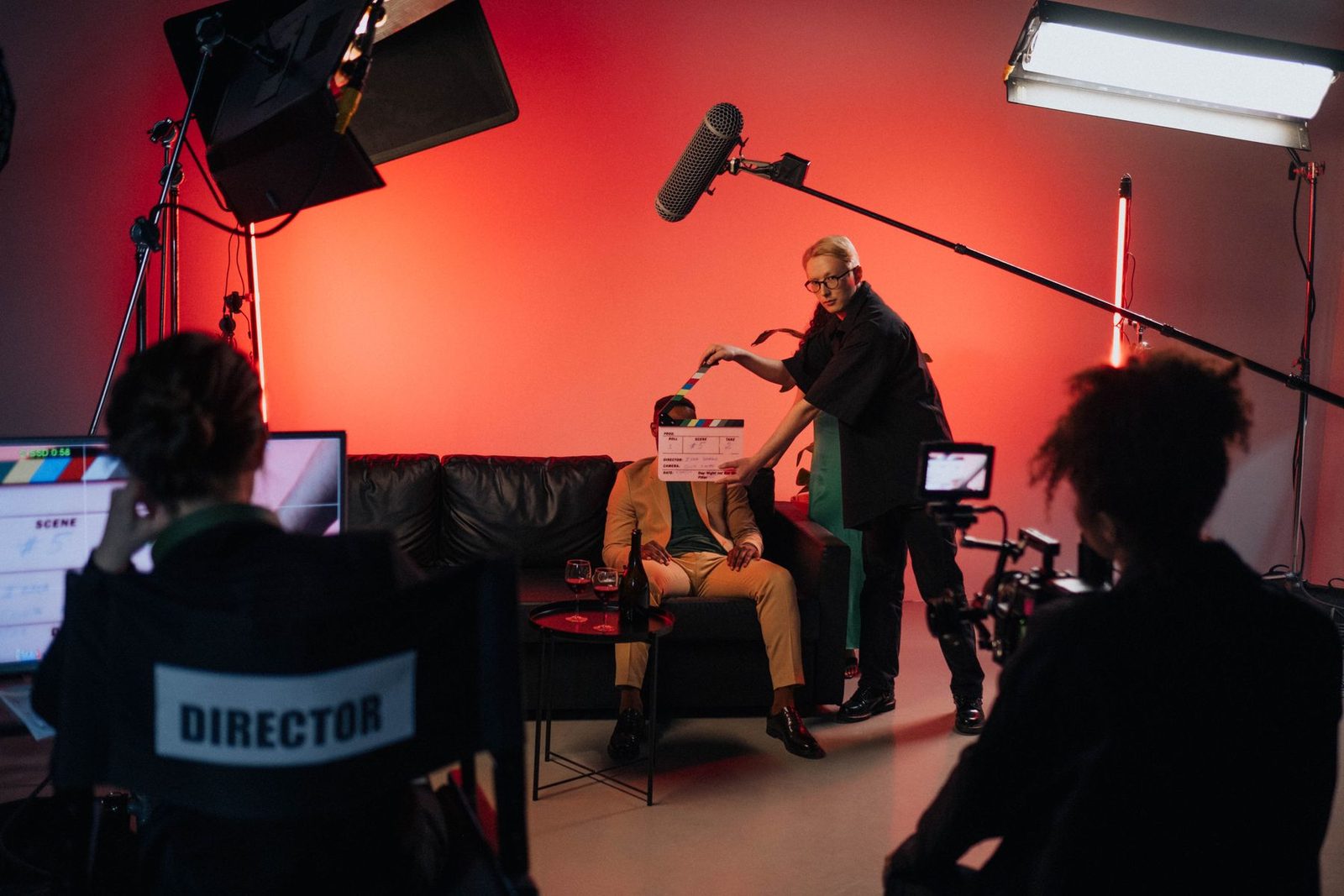
The erotic industry in Germany does not consist of a handful of firms, but of five levels that depend on each other: production companies, distributors and labels, platforms, agencies and agents, and the performers themselves. Anyone who starts out ends up negotiating with one of these levels — and the contract looks very different depending on which. This article describes the build, the path of the money and the place at which you yourself sit in this chain. Reliable market figures for that do not exist, because hardly anyone involved publishes under a reporting duty. The structure can still be described.
Five levels that together make the market
The terms are mixed up in everyday talk. For you the distinction matters, because each level wants something different from you and has something different to offer.
- Production companies shoot. They carry location, crew, technique, fees and the risk that a shoot day falls away. They cast roles and conclude the contracts with you.
- Distributors and labels exploit the finished material: they bundle it under a brand, license it on and settle with buyers. Some firms produce and distribute at the same time; then the line blurs.
- Platforms supply the reach and the payment system. They usually do not produce themselves, but keep a share of the turnover.
- Agencies and agents bring cast and production together. They do not shoot and they do not exploit; they cast.
- Performers provide the performance — almost always as self-employed people, not as employees.
In practice the levels are not cleanly separated. There are firms that produce and at the same time distribute under their own brand. There are productions that cast their own newcomers and run their own applicant portal for that. And there are platforms that, beside other people’s material, also offer their own productions. These mixed forms are not the problem — what is problematic is only if they are not made identifiable.
If you want to know whom you are dealing with, ask about the level: who shoots, who exploits, who casts. Anyone who answers that evasively has earned the follow-up. The difference is concrete: a production offers you a shoot day, an agent offers you access to several productions, and a platform offers you infrastructure but no fee. Which role the individual people involved have on a concrete shoot day is shown in the overview of the different types of production.
How the money runs through the chain
At the start there is always a payment from outside: a subscription, an individual purchase, a licence fee, an advertising receipt. From there the money travels backwards through the chain, and each level keeps a share before the rest goes on.
The platform keeps its share of the turnover. The label or the distributor keeps its share of the licence. What arrives at the production company has to cover the costs of the shoot day: location, technique, crew, hair and makeup, post-production — and the fees. Those fees are the point at which you appear in the chain.
For you that has an important consequence: in classic production you are paid for the shoot day, not given a share of the success. On photo productions the day rates usually sit between 250 and 600 euros, on video productions between 400 and 1,200 euros. Whether a scene later finds ten or ten thousand buyers changes nothing about your fee. That is not fraud, but the logic of a Buyout: the production pays at once and carries the exploitation risk alone.
Usually not included in the fee are the side costs of your working day. Whether travel is reimbursed, whether an overnight stay is covered and whether waiting times are paid is a matter of negotiation and does not automatically stand in the contract. On health proofs the position is clearer: an STI-Panel is borne by the booking production, because it is a condition for the shoot and not your private precaution.
On platform work it runs the other way. There is no day rate, but a share of the turnover. Platform payout rates sit between 25 and 90 percent — a difference that decides more about your result than the number of hours you invest. How the two paths differ in calculation is set out in the article on pay.
Why almost everyone in this industry is self-employed
Permanent employment for performers is the exception in Germany. Production happens project by project, often with a few days’ lead, and production companies do not keep a cast in stock. That also applies to a large part of the crew: camera, lights, hair and makeup and assistance often work on invoice as well.
Self-employment in practice means that nobody provides for you. There is no continued pay if you fall ill, no paid holiday, no employer’s share of health insurance and no automatic pension entitlement. If a shoot day falls away, the fee falls away. Anyone who works regularly should therefore from the start set aside part of every fee for tax and insurance, instead of treating it as income. The tax side is explained in detail in the article on trade and tax.
The shift from studio shoot to own production
The exploitation paths have shifted over the last two decades. Where physical media, mail order and video stores used to bring the income, they now run mainly through on-demand portals and fan platforms. That has not abolished the chain, but shortened it: anyone who rents reach and a payment system no longer needs a label to sell material.
That becomes visible in the size of the productions. Beside the firms with a standing crew and their own studios, many individual producers now work who combine camera, direction and distribution in one person. Both exist in parallel, and both can be serious — but the standards differ considerably.
What that means in practice for newcomers
From the shift it follows for you that there is no longer one start, but two fundamentally different ones. On the first you are booked: you shoot for a production, receive a day rate and grant usage rights. On the second you produce yourself and sell through a platform.
The first path is more predictable and needs no audience. You learn in advance what is being shot, with whom, for how long and for which fee. The second path gives you more control over content and exploitation, but asks for lead time, stamina and marketing — and in the first months it usually pays little.
Many therefore work on both levels: shoot days bring money and visibility in the short term, an own channel builds an income in the long term. Anyone who combines both should, however, look into the contract beforehand to see whether the production demands exclusivity.
What is not known about this market
On the size of the German erotic industry there are no reliable figures: no industry turnover, no number of production companies, no number of people involved. The reason is simple — hardly any company in this field publishes reportable figures, and many work as a small business or a sideline.
If someone names concrete market figures to you, ask for the source. Something else is striking: in a review of the known German-language casting and production sites, not a single one names its own day rate. Anyone looking as an applicant for a basis for a decision finds mood there instead of terms. That is exactly why this site states how we work and what we are paid from — checkable and in figures.
Note: This article places the practice in general terms and is not a substitute for legal or tax advice.
Questions about this?
Schreib uns, oder sieh dir an, wie eine Zusammenarbeit abläuft.