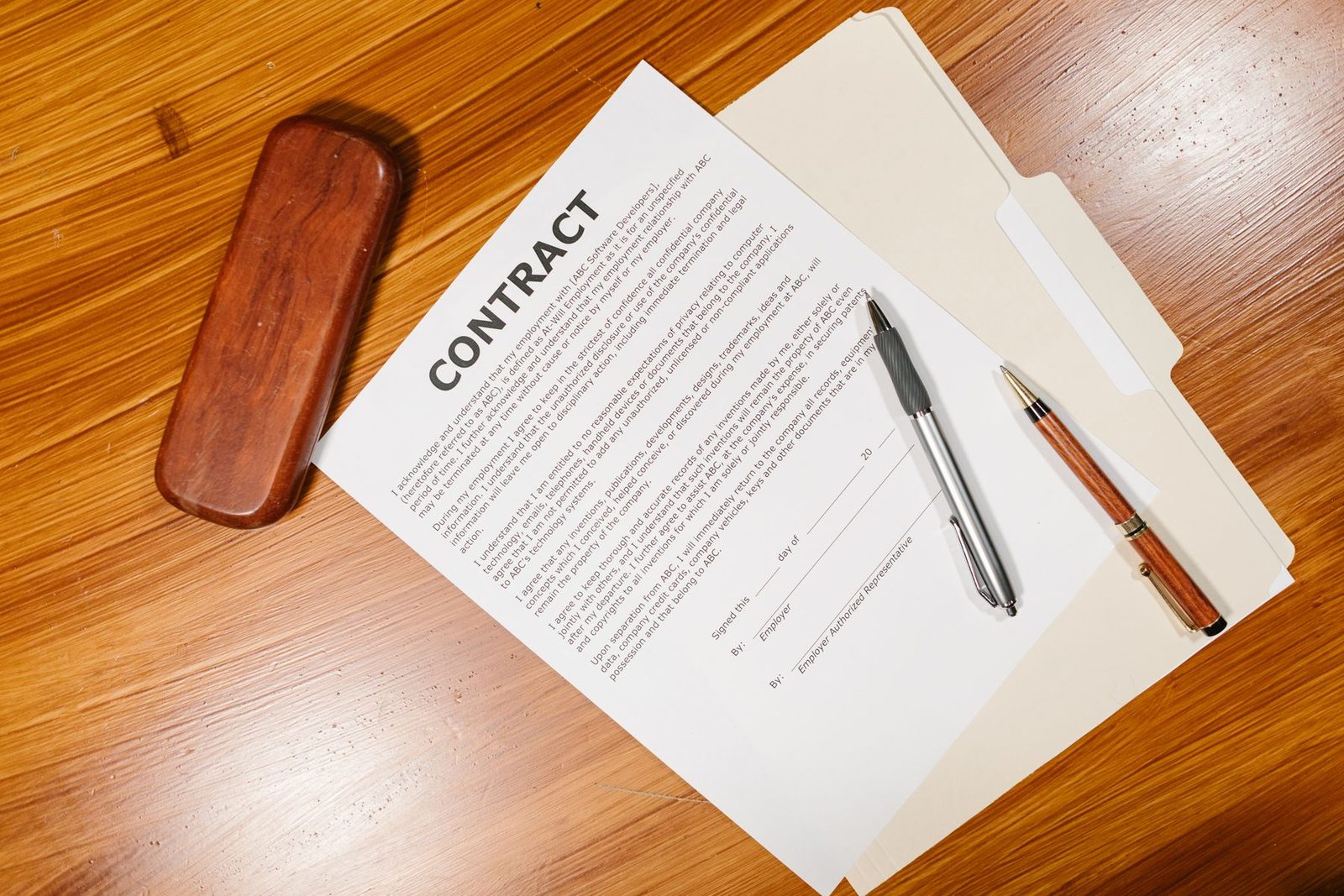
The model contract of a porn production decides where your material is seen in ten years. It is usually signed in five minutes, often in the studio, often while lights are already being set in the background. Those five minutes are the most important of the whole shoot day, because they are the last moment at which something can still be changed. This article goes through the document from front to back: which papers belong to it, what has to stand in which section, and which clauses are a reason not to sign.
What all belongs to the contract
A model contract is rarely one sheet. Usual is a stack: the contract itself with performance, fee and deadlines, plus a consent and release declaration that in the industry is called a Model Release, your limits list as an annex and often a confidentiality declaration.
Annexes only work if they are expressly named in the contract and signed and dated together with it. A list you pressed into someone’s hand in the morning is not part of the contract, but a note.
If a page is missing from the stack, it is missing later as well. And you take a signed copy with you — if none is handed over, photograph every page before you leave the set.
The contracting parties: who your client is
The contracting party is the production, not the agency. We place; we are not the client. That has a practical consequence: claims to the fee are directed against the production, and that is why it has to be clear who this production is.
Full company name, legal form, address and, for registered companies, the register number belong in the contract. Sole traders have no register number; then name and an address that can be served have to be right. If a reachable address is missing, do not sign — a contracting party you cannot write to you also cannot take to task.
Two points are regularly overlooked. Is the firm in the contract the same one that booked you? And does a person authorised to represent the production sign, or whoever on set happens to have time?
Performance and payment
Here stands what is being shot, when, for how long and what you receive how much for. Three facts decide: is the shoot duration limited, or does an open formulation such as “until completion” stand there? Is the fee named as an amount, and is it recognisable whether VAT is included or comes on top? And when is payment made? Usual are 14 days after invoicing, by transfer, with a statement you can check.
If overtime is possible, it should be regulated how it is paid. Without a rule it is settled with the day rate, and an eight-hour day becomes a twelve-hour one at the same price. A cash payment without a statement is also no advantage: without receipts you can explain neither income nor expenses comprehensibly.
Four points are often missing and belong in: travel costs, waiting time on shifts on the shoot day, a cancellation fee if the production cancels at short notice, and the rule for a stop. Which ranges are usual at all is on our pay page — without those orders of magnitude a named fee cannot be placed.
Usage rights and Buyout
This is the clause with the longest effect: the shoot lasts a day; the rights granted may run without limit. Four dimensions are negotiable one by one.
- In time: unlimited or limited. The default is “unlimited in time”; a limit is negotiable, but often lowers the fee.
- In space: worldwide or limited to certain countries. A restriction to the German-speaking area is possible, but has limited effect on the net.
- In content: which media and channels. “All media, including future ones” is the widest formulation; tighter is only streaming, only the subscription area, not as a trailer.
- Transferability: may the production resell the rights? Then your material can land with a company you did not choose. This clause is the one most often skipped.
What the individual formulations mean in practice is in the article on period, territory and channels. For this overview a mnemonic is enough: what you grant here you practically do not get back.
On a Buyout everything is settled at once — one payment, all rights done, no later payment on reuse. That is the rule in this industry and not in itself bad, because it makes the billing simple. It does mean, though, that you have no share in later exploitations, even if a scene runs successfully. Anyone who wants a share negotiates it before the contract is concluded; the calculation behind that stands in the article understanding Buyout.
A core still stays with you: what the right to one’s own image covers you recognise in the contract from how precisely the consent is worded.
Consent, limits and age documentation
The consent to the recording is more than a formality. It should record that it was given voluntarily, and name which acts are covered. A reference to the attached Yes-No-Maybe list is permissible and the cleanest path, because it does not fill the contract with enumerations.
The principle for that is short: what does not stand on the list is not agreed. A clause that covers “all acts usual in the frame of the production” is not a consent, but a blank cheque.
Before publication a withdrawal is as a rule possible; afterwards it becomes difficult, because your right to your own image collides with the usage rights granted. Some contracts provide a time-limited right to withdraw, for example 14 days after the shoot; asking about that costs nothing. What is still enforceable later is in the article on deletion and withdrawal.
The production has to document your legal age and keep the papers; that includes a copy of identity card or passport; a driving licence is not enough. This documentation is not public and serves proof towards authorities and platforms. Nothing is to be negotiated here.
Clauses we advise against
- Contractual penalties for cancellations without a corresponding rule in your favour if the production cancels.
- Exclusive binds without consideration. Anyone who only shoots for one production should be paid for that.
- A blanket transfer of rights “to third parties at the client’s choice” without a reservation of consent.
- Confidentiality clauses that forbid you to speak about the working conditions. Staying silent about trade secrets is usual; staying silent about poor treatment is not.
- A complete exclusion of withdrawal or a withdrawal tied to a payment duty.
- A place of jurisdiction abroad on a production that shoots in Germany.
A single one of these clauses is no reason for panic, but for a question; it can come from a template nobody has questioned. Two or three together describe an attitude, and that does not change on the shoot day.
How you review the contract in twenty minutes
Have the document sent by mail at the latest 24 hours before the shoot. Read it once in full and a second time only with four questions in your head: who is my contracting party? How much do I receive, and when? What may happen to the material, where and for how long? What applies if I cancel or stop?
Mark what you do not understand, and send the questions back in writing. You want the answers in writing as well: a written promise can be read later, an oral one cannot.
We look at the contract before the signature and tell you in ordinary language what stands in it. That costs you nothing and is not legal advice; if something does not add up to you, the path to a media lawyer is worth it.
The most important sentence at the end: do not sign anything on set that you have not read beforehand. A production that puts the contract in front of you only in the studio has either organised badly or counts on you not reading under time pressure.
Note: This article places the practice in general terms and is not a substitute for legal advice in the individual case.
Questions about this?
Schreib uns, oder sieh dir an, wie eine Zusammenarbeit abläuft.