Almost everything that is told about porn shoots comes from the finished product. That is obvious and still misleading, because a film shows twenty minutes out of twelve hours of work, and the eleven hours and forty minutes that were cut away are the part that matters for you. The following seven assumptions meet us regularly in application conversations. Each is set here against the practice, with what can be shown and with what remains open. Where the answer is uncomfortable, it still stands there.
Myth 1: “On set everyone is constantly aroused”
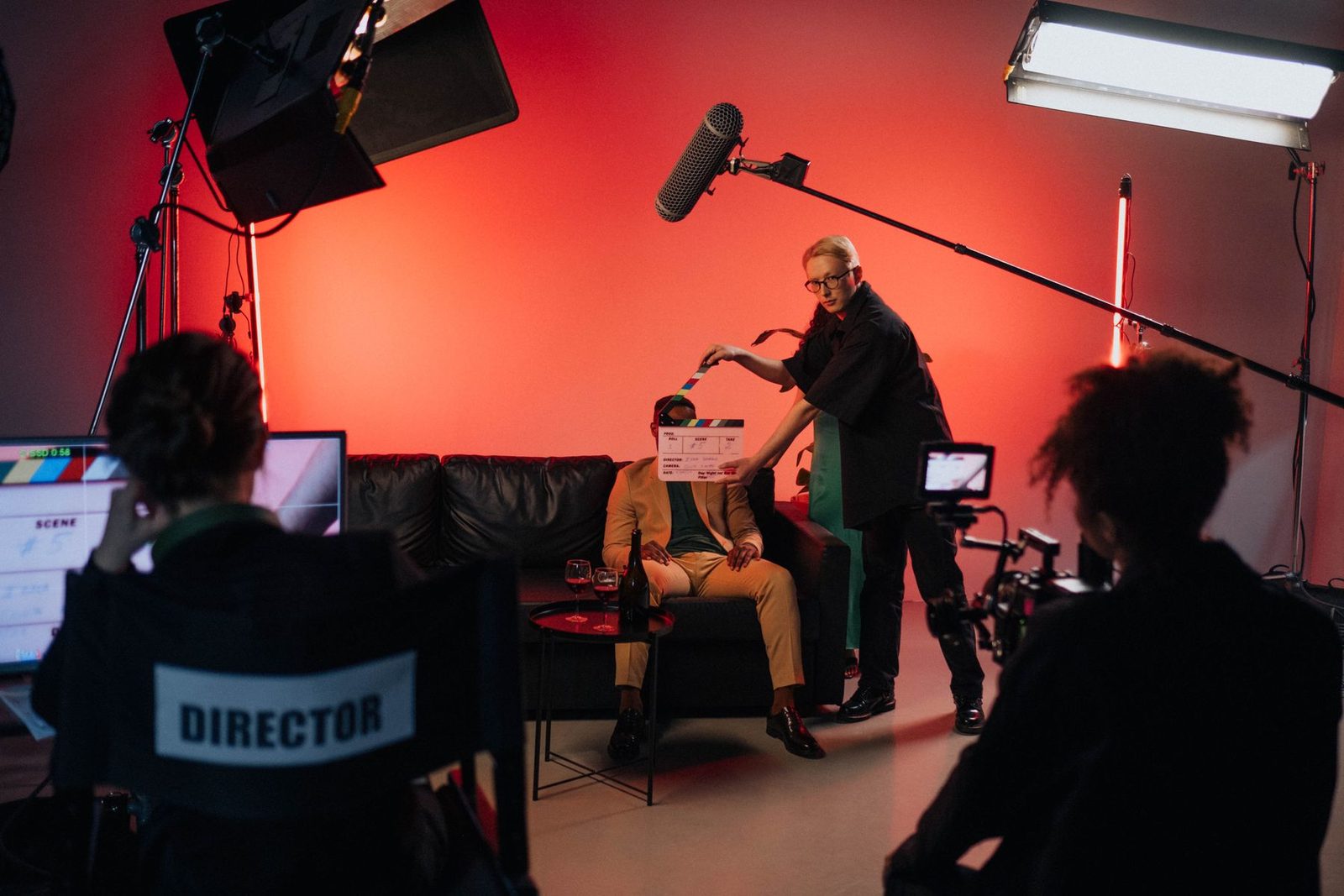
A shoot day is work, and work feels like work. Between the shots light is reset, sound is checked, the angle is changed and continuity is controlled. People talk, drink, look at their phones. The basic mood on a functioning set is concentrated and friendly, not charged.
That has an important consequence for you: lasting arousal is not expected of you. What is expected is that you carry out directions, hold positions and keep arrangements. Physical reactions come and go, that is known, and an experienced team plans with that.
Where the myth comes from is no secret. The finished video shows exactly the minutes in which something happens and cuts away the hours in which cables are laid and apertures are adjusted. Anyone who concludes from the result to the working process inevitably arrives at a wrong picture.
Myth 2: “Everything is shot in one take”
Shooting happens in short sections. The same act arises in several takes, from different angles, with position changes that serve the picture and not the feeling. In between the lighting is corrected because a shadow falls wrongly, or a new start is made because a noise from outside ran into the sound track.
On top of that, shooting does not happen in the order in which the scene is later seen. What in the finished video follows immediately on one another can on set lie hours apart, because what needs the same lighting is shot together.
For those involved that means: it is stopped and taken up again, often in the middle of a movement. That is the point at which newcomers are most surprised, because the finished result shows nothing of these cuts. What follows from that for your craft is in our article on the work around casting and the shoot date.
Myth 3: “Anyone who shoots once is fixed for ever”
Here the honest answer is: partly right, and still misunderstood. Right is that published material remains. What was on the net may have been copied, and a deletion at the contracting party does not reach foreign copies. Anyone who presents that differently promises something they cannot keep.
Wrong is the conclusion many draw from that. The activity itself is not a one-way street. People shoot for two years and then no more, continue as a sideline or change completely. What you can influence is the scope of the usage rights you grant: period, territory, channels. This decision falls before the first shoot and not afterwards, and it is more important than the question whether you shoot at all.
Myth 4: “You have to go along with everything”
No. The Yes-No-Maybe list is part of the contract, not a polite statement of intent. What is excluded there is not demanded, not even against a supplement and not even with the argument that everyone else does it.
On top comes the right to stop at any time, even on something you previously consented to. Consent is not something you grant once in the morning and that then applies for the whole day. Before shooting starts it is fixed who your contact is and which word stops the shoot at once. A no has no consequences for the agreed fee. How these rules are organised with us is under safety on the film set.
The myth holds because it is thought from the wrong side. One imagines that on set an expectation pressure arises to which one is exposed. In fact it runs the other way: a production plans with what has been accepted, because everything else costs time and money. Your list is just as useful for the planning as for you.
Myth 5: “In the industry there are no rules”
There are rather more rules than in many other fields; they are only invisible outward. Three examples that affect every shoot day.
- Condom duty. For vaginal and anal intercourse it applies without exception and independently of whether everyone involved presents current tests.
- Test duty. What is proved is an STI-Panel that on the shoot day is no older than 14 to 30 days. The costs are borne by the production.
- Documentation duty. Without documented age proof through identity card or passport nothing may be published. That is why on set the identity document is checked and copied, and that is why a driving licence is not enough.
Where these rules are missing, that is not a sign of freedom, but of unprofessionalism. A production that evades them risks its own exploitability and your safety at the same time.
Myth 6: “Everyone takes drugs”
On serious sets not. The reason is less morals than legal validity: a consent given under alcohol or drugs is not reliable, and with that the basis on which shooting may happen is missing. Productions that want to work in a plannable way have no interest in that.
What follows from that for you is more important than the correction. A set on which alcohol or substances circulate is a warning sign, independently of how relaxed the mood seems. As a rule other things are missing there as well: clear arrangements, papers, breaks, contacts. In this situation the rule is: stop, leave, report. Reliable figures on the spread of substance use in the German industry do not exist, and we invent none.
Myth 7: “A shoot day brings a lot of money for little effort”
The day rates are decent. A video production sits between 400 and 1,200 euros per shoot day, a photo production between 250 and 600 euros, an event accompaniment without sexual acts between 200 and 500 euros. That is the part that is true.
The other part: a shoot day with travel, preparation, waiting time and wrap often means ten to twelve hours. From that travel costs, preparation and tests come off, and as a self-employed activity the profit has to be taxed. Payment is within 14 days by transfer, not on set.
Above all the order book is irregular. Anyone who is new rarely shoots often in the first months, and a day rate times a wished-for number of shoot days does not make a yearly income. How the calculation looks realistically we have written down in What a performer earns.
Note: This article places the practice in general terms and is not a substitute for legal, tax or medical advice.
Questions about this?
Schreib uns, oder sieh dir an, wie eine Zusammenarbeit abläuft.