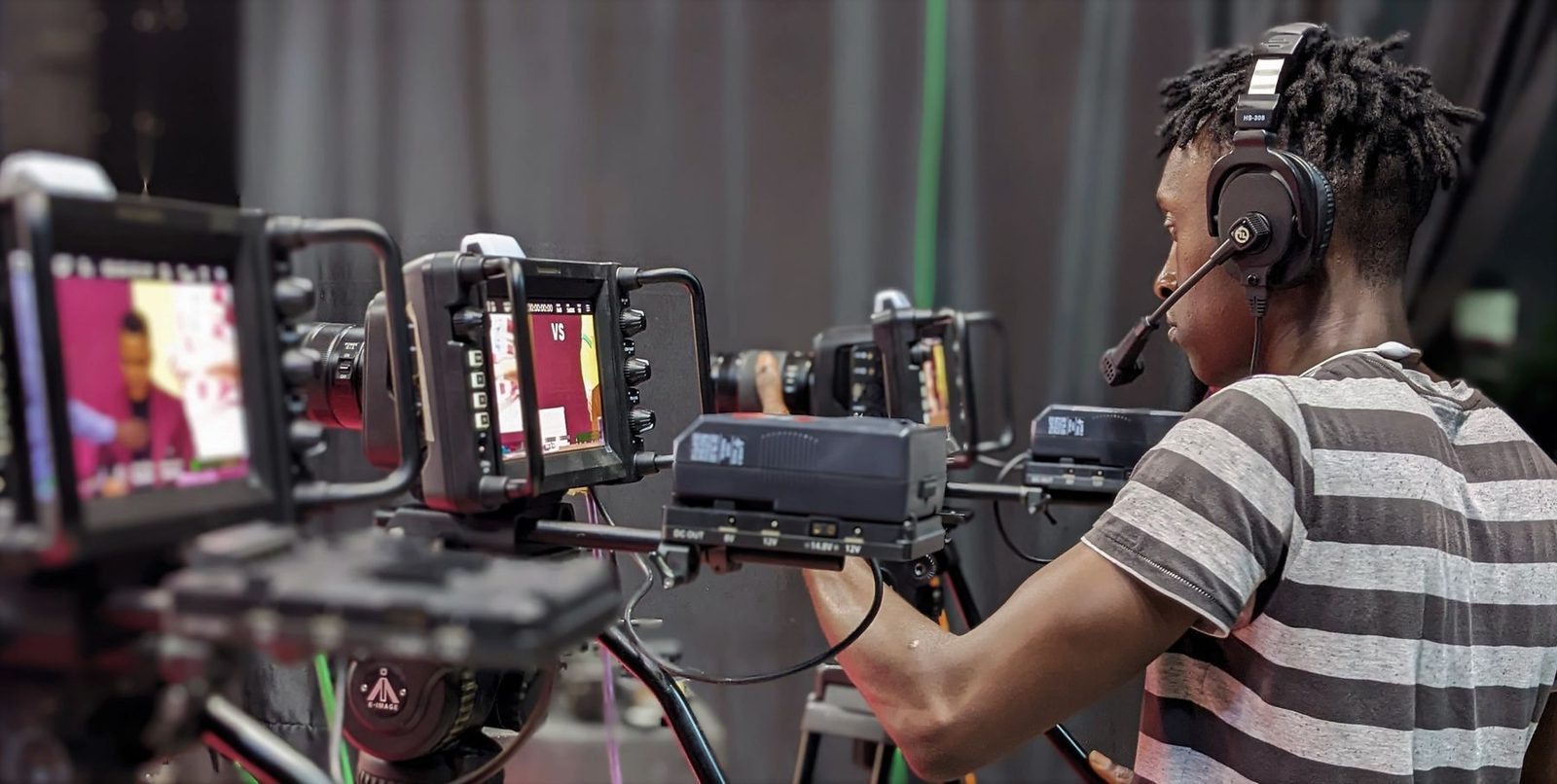
Anyone who comes onto a set for the first time sees five to ten people all doing something, and knows of none of them what they are responsible for. That is uncomfortable, because in this situation you address nobody and keep questions to yourself. This text dissolves that: which roles there are, what they may decide, who has authority to give you instructions and who does not, and whom you turn to with which problem. At the end stands how you recognise that a crew is too thinly staffed.
Production management: your first address
Production management organises the day. It plans the timetable, is responsible for the contracts, checks the ID documents for the documentation duty, checks the test proofs, settles the statement and is the interface to the agency.
For you it is the most important person on set, namely on everything that is not purely technical: discomfort, an agreement that is not being kept, a process that departs from the booking, a question about the fee, an incident. If you cannot identify them in the morning, ask before filming starts. A set without a named contact is a poorly organised set.
Direction: the content lead
Direction decides what is shot and how it should look. It gives the instructions during a shot, determines pace, eyeline and positions and decides whether a take is repeated.
These instructions are terse and sound technical because they are technical. What matters is the limit: direction leads on content within what has been agreed. It does not widen the frame. What is excluded in your limits list is excluded for direction as well, independently of how good an idea currently appears.
Camera, lights and sound
These three areas produce the picture and the soundtrack, and a large part of the interruptions comes from them.
- Camera. Picture design, crop, focus, movement. On larger productions assistances come in who are responsible for focus and material.
- Lights. Builds the lighting and corrects it between takes. From this department come the waiting times that demand the most patience.
- Sound. Places microphones, watches for noise, stops for an aeroplane or a rustle. If someone asks you to take jewellery off, the request usually comes from here.
On smaller productions two or three of these tasks sit in one hand. That is normal and not automatically worse, as long as it is clear who is currently performing them. The technical terms that come up can be looked up in the lexicon of industry terms.
Makeup, set assistance and continuity
Makeup takes on hair and make-up, touches up between shots and sees to it that under the lights you look as planned. Tell them before starting if you react sensitively to products or have brought your own cosmetics.
Set assistance keeps the operation running: props, towels, drinks, resets, paths. They are often the person you see most during the day and who solves small problems fastest.
For continuity someone watches that between two takes what has to stay the same stays the same: hair, jewellery, clothes, the position of things in the room. On larger productions that is a task of its own; on smaller ones direction or camera takes it on beside their other work.
Intimacy Coordinator
This role comes from film and television production and is increasingly to be met in erotic productions as well, but it is not the standard. An Intimacy Coordinator mediates between direction and those involved, plans intimate shots in detail in advance, checks whether agreements are being kept, and is reachable during the shoot without themselves contributing to the result.
The practical use sits in the relief: you do not have to defend your limits yourself against a production’s time pressure; there is someone whose task is exactly that. If a production fills this role, that is a good sign. If not, production management has to take on the function, and you should know who is performing it.
Who has authority to instruct and whom you turn to
Instructions on the shoot are given by direction and production management, and within the contract, the schedule and your limits list. Camera, lights, sound and makeup give professional notes in their area, for example on position or jewellery. That is the frame, and it is not stretchable.
Not authorised to instruct are all others: other performers, companions, drivers, guests, acquaintances of the production, someone who is “there for the client”. If an instruction comes from that direction and departs from the agreement, you do not carry it out, but go to production management.
And over everything stands what is not negotiable: you can stop at any time, including on something you previously agreed to. For that there is an agreed word and a named contact, set before filming starts, and a no has no consequences for the fee. Which protection rules apply with us is under safety on the film set.
For everyday life on set the assignment is simpler than it feels in the moment.
- A technical question about the picture or the position: camera, if need be direction.
- It dazzles, it is too hot, you cannot see: lights.
- Hair, make-up, a skin reaction: makeup.
- Towel, drink, prop, dressing room: set assistance.
- Discomfort, circulation, a break, a stop: production management or Intimacy Coordinator.
- An agreement is not being kept, a limit is being touched, fee or papers unclear: production management.
- The production does not react appropriately: us, even still on the shoot day.
Studio production and a small amateur production
On a studio production the roles are filled separately. That means more people in the room, longer waiting times through resets, but also clear responsibilities, documentation, regulated breaks and several people who notice something.
On a small production tasks bundle. One person directs, holds the camera and is at the same time production management. That is permissible and can work well, but it requires that contracts, test proofs, ID documentation, the condom rule and a contact are regulated just as they are in the studio. Which production types there are and how they differ is under erotic productions in Germany.
A set with only two people, you and one other, is by contrast a warning sign. Then there is nobody who witnesses anything, nobody you can turn to if that one person is the problem, and in practice contracts and documentation are usually missing there as well. For the same reason at least three people are present at our castings, and a trusted person may come without prior notice. Ask before the acceptance how many people will be on site on the shoot day. The answer tells you more about a production than any self-description.
Questions about this?
Schreib uns, oder sieh dir an, wie eine Zusammenarbeit abläuft.